「ビジネスにおいて、最も恐れるべきは『無能な働き者』である」 ……あまりにも強烈すぎるこの言葉、あなたも一度は耳にしたことがあるのではないでしょうか? 「毎日誰よりも遅くまで残業して、やる気だけは人一倍ある。なのに、良かれと思って勝手に突っ走ったあげく、いつも特大のミスをやらかす。そして、その尻拭いをするのは決まって自分……」 あなたのオフィスにも、そんな「やる気のある無能」に周囲が振り回され、現場が崩壊しかけている地獄のような状況はありませんか? 今回は、この強烈な組織論の真実を紐解き、「無能な働き者」に振り回されて疲弊している現場の被害者のあなたへ向けて、その特徴とサバイバルな対処法をプロ社畜の視点で徹底解説します!
※当ページは一部にプロモーションを含みます
- ドイツの軍人たちが導き出した「ゼークトの組織論」とは?
- 無能な働き者とは?ゼークトの組織論が突きつける「人間の本質」
- あなたの周りのアイツは大丈夫?「無能な働き者」危険度チェック
- 被害者になっていないか?「上司」が無能な働き者の場合の対処法
- 部下が「無能な働き者」だった場合の正しい対処法は?
- 【モルトケの法則】有能な働き者より「有能な怠け者」が重用される理由
- まとめ:他人の暴走に巻き込まれない「大人の賢さ」を身につけよう
- “The Flawed Hard Worker”: Spotting the Office Liability and Mastering the Art of Not Getting Caught in the Crossfire
ドイツの軍人たちが導き出した「ゼークトの組織論」とは?
そもそも、なぜ「無能な働き者は銃殺せよ」などという過激な言葉が生まれたのでしょうか。 この元ネタは、1920年代のドイツ陸軍総司令官であり、大戦後に縮小された軍の再建に大きく貢献した名将ハンス・フォン・ゼークト(および、同じくドイツの名将モルトケやハンマーシュタインら)の言葉が源流とされています。
軍隊という「一瞬の判断ミスが全員の死に直結する」極限の組織において、彼らは部下の本質を4つのタイプに分類し、適材適所の配置を行いました。 それこそが、現代のビジネス界でも語り継がれる「4つの適性分類」です。
無能な働き者とは?ゼークトの組織論が突きつける「人間の本質」
ドイツ軍の組織論では、人間の適性を以下の4つのマトリクスに分類し、それぞれの役割を明確に定めました。あなたの周りの同僚や上司を当てはめながら見ていきましょう。
- 利口
- 愚純
- 勤勉
- 怠慢
ビジネスにおいては下記のように分類されます。
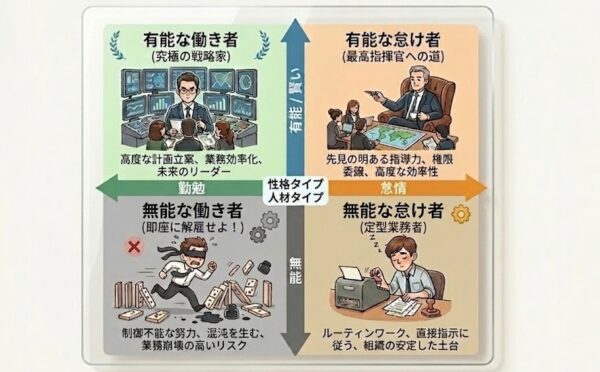
| 勤勉(働き者) | 怠慢(怠け者) | |
| 利口(有能) | 有能な働き者(参謀向き) | 有能な怠け者(指揮官向き) |
| 愚純(無能) | 無能な働き者(※即刻排除) | 無能な怠け者(下級兵士向き) |
利口 ✕ 怠慢 = 有能な怠け者(高級指揮官向き)

「自身で動かずに上手に人を使うことが出来る者こそ、最も優れた高級指揮官である」
「有能なのに怠け者」と聞くと意外に思えるかもしれませんが、彼らは自分が楽をしたい(サボりたい)がために、「どうすれば最も効率よく、最短で、他人に任せて成果を出せるか」を必死に考えます。
特性を見極めて部下に的確な指示を出し、最大限の成果を得る。これこそが、経営者やトップリーダーのあるべきポジションです。

怠け者だからこそ、指示系統をハッキリさせて組織を賢く動かせる。やっぱりトップが優秀で適度に現場に任せてくれる組織は強いように感じますね!
利口 ✕ 勤勉 = 有能な働き者(参謀向き)

「優秀で自ら行動できる者は、作戦や計画を立てる参謀に最適である」
指揮官の下で作戦や計画を緻密に練り上げ、現場への的確な指示や策略を自ら行動して実行に移せるポジション。会社組織でいえば、実務をゴリゴリ回す「優秀な中間管理職」や「エースプレイヤー」がこの立場にあたります。
抜群のスキルで現場を引っ張る頼れる存在。ただし、「名プレイヤーが名監督になるとは限らない」と言われるように、次のステップ(指揮官)に上がるには全く異なるスキルが必要になります。
愚純 ✕ 怠慢 = 無能な怠け者(下級兵士向き)
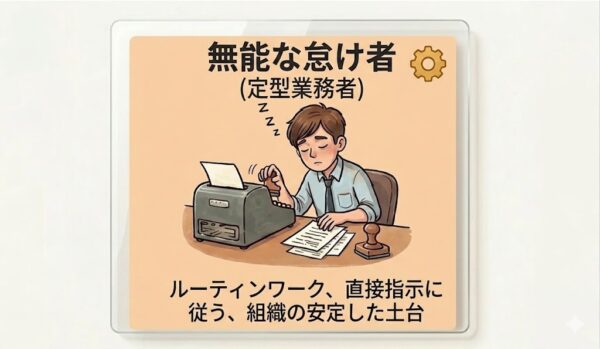
「自分で判断させず、命令を忠実に実行するルーティンワークを任せよ」
自分で新しいアイデアを出したり、自発的に動いたりはしませんが、言われた命令(マニュアル)は忠実にこなすタイプです。
ゼークトの組織論では、組織の約8~9割をこの層が占めるべきとされています。指示を受けて現場での単純作業や、定型化されたルーティンワークを主とする業務において、組織を支える重要な歯車となります。
ドキッとしたかもしれないけれど、会社員の多くはある意味このポジションが一番ラク。「自分で責任を取って成果を上げるより、言われたタスクをこなして給料をもらう方が確実」という割り切りも、組織の安定には必要不可欠なんですね。
愚純 ✕ 勤勉 = 無能な働き者(※組織から排除せよ)
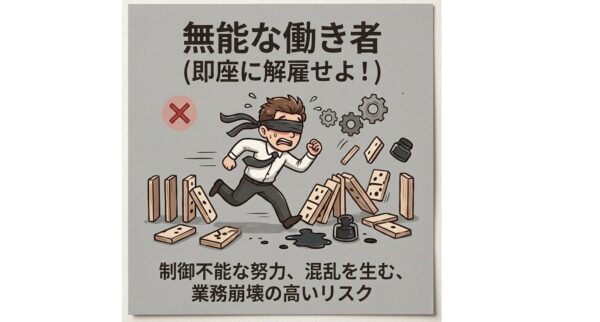
「最も恐れるべきは、能力がないのにやる気だけがあり、勝手に行動する者である」
軍隊において、最も危険視され「銃殺するしかない」とまで酷評されたのが、この「無能な働き者」です。
本人はやる気満々で一生懸命なのですが、上司からの指示を勝手に自己解釈し、相談もなしに暴走したあげく、周囲を巻き込む致命的なミスを犯します。さらにタチが悪いのは、本人に「悪気」がなく「頑張った」と思っているため、物事の本質を理解せず、何度も同じ過ちを繰り返す点です。
規律を乱し、組織に最大の損害を与えるため、重要な役職を与えてはならない(むしろいなくなってもらった方がいい)とされているのです。
「頑張れば頑張るほど、現場が混乱して周囲の仕事が増える……」。無能な働き者の『悪意なきやる気』ほど恐ろしいモノはありません。被害を被っている現場のあなた、次のチェックリストでアイツの顔を思い浮かべてみてください。
次の項目で自身や同僚がこの無能な働き者に当てはまるかチェックしてみましょう
あなたの周りのアイツは大丈夫?「無能な働き者」危険度チェック
現場を崩壊させる「無能な働き者」には、驚くほど共通する特徴があります。あなたのオフィスの「困ったちゃん」に当てはまっていないか、チェックしてみましょう。
報連相(ホウレンソウ)が苦手なのに、事後報告だけは早い
無能な働き者はほうれんそうが苦手で、考えるより勝手に突っ走って事後報告が多い特徴があります。ほうれんそうを怠ると以後の仕事の進行が難しくなり、自身の信用問題に直結します
無能な働き者が中心で回っている仕事など世の中にありません
考えるより先に勝手に突っ走るため、相談なしで勝手に物事を進めます。トラブルが取り返しのつかない規模になってから「実は……」と持ってくるため、周囲の尻拭いコストが跳ね上がります。

まったく同じ単純ミスを何度も繰り返す
一度注意した作業においても物事の本質を理解していない・理解することが出来ない為、注意された物事の応用が出来ません。この方に共通する謝り方は「すみません」です。
「その場の謝罪パフォーマンス(とりあえず『すみません』を連発)」でやり過ごすため、物事の本質やロジックを理解していません。そのため、少し形が変わると応用が効かず、同じミスを量産します。

謝っているパフォーマンスだけでは成果は得られません
根拠のない「勝手な自己判断」で暴走する
想像力や危機管理能力に欠けており、前例がない仕事でも「たぶん大丈夫だろう」と楽観的に着手します。失敗した時の被害への想像力が致命的に欠如しています。

楽観的に着手するあまり失敗したときの被害が甚大になったり、指示を仰ぐまで一切動けないと納期も守れず、会社が取り返しの付かない被害に合うこともあります。いずれの場合も、その後の想像力が欠如しているが為の勝手な自己判断のように垣間見えます。
無駄に仕事を抱え込むくせに、成果が圧倒的に低い
作業効率が悪いのに、なぜか自分のキャパシティ以上の仕事を抱え込もうとします。そして「こんなに夜遅くまで残業して頑張っている自分」に酔いしれ、悦に浸る傾向があります。
そもそも仕事を抱え込むこと自体、勘違いだと言うことが多いのですが、本人はわかっていません

責任感を「はき違えて」周囲の意見を聞かない
仕事の責任とは「納期とクオリティを死守すること」ですが、彼らは「自分が最後まで抱え込むこと」が責任感だと思い込んでいます。他人に仕事を振られると不服そうにし、結果として全体の進捗をストップさせます。
無能な働き者は上司が周囲に仕事を割り振ることを不服に思い愚痴が多くなります。 責任という言葉をはき違えているが為、周囲は無能な働き者のペースに合わせるほか無く、結果として全てが滞ることとなります。仕事の責任とはきちんと納期を守ることです

異常なほどプライドと自己評価が高い
自分自身が無能であるという自覚が一切ありません。立ち直りだけは異常に早く、他人のアドバイスを見下したり、ミスの原因を環境や他人のせいにしたりするため、周囲との評価のズレが広がる一方です。

自己評価が高い人間に共通することは自分自身が無能だということに気がついていません。ほうれんそうや自己判断などに付随する特徴が垣間見え、プライドが高く人を見下す傾向があるとも言えるでしょう。そのような人は失敗やミスの原因が自身に落ち度があっても異常なまでに立ち直りが早く、自身と他者の間に評価のずれが生じやすいのです。
被害者になっていないか?「上司」が無能な働き者の場合の対処法
会社組織において上司は部下を選べますが、部下が上司を選ぶ事はまずありません。もし、あなたの「直属の上司」がこの無能な働き者だった場合、部下であるあなたの精神と時間は削り取られる一方です。
ここで知っておくべきなのが、組織の経験則である「ピーターの法則」です。
ピーターの法則を理解した組織の元で働こう
ピーターの法則とは、ローレンス・J・ピーターにより提唱された法則であり、
あらゆる有効な手段は、より困難な問題に次々と応用され、やがては失敗する
この法則を現代の会社組織に応用すると、
能力のある人間は出世していくが、やがて自分の能力の限界値(無能になるポジション)に達したところで昇進が止まる。その結果、組織の中間管理職は「無能な管理職」で埋め尽くされ、組織全体が無能化していく。
「プレイヤーとしては優秀だったのに、上司になった途端に無能化した」というのはよくある話。人を管理する訓練を受けていないのに、やる気だけが空回りして「仕事を抱え込む」「手柄を横取りする」「雑に仕事を振る」という最悪の上司が誕生してしまうのです。
ここで怖いのは、上司無能な働き者であるが故に仕事にもその特性が出てしまうことです。
- 仕事を抱え込んで放さない
- 手柄を得ようとする
- 気がついたら、退職者が増えている
- 仕事の振り方が雑
- 締め切り意識がない
- 成果が上がらない仕事ばっかりしている
- 優柔不断、判断力が無い
その他の、無能な働き者の上司の対処法
- さらに上の上層部(役職者)へ事実ベースで相談する
感情論ではなく、「上司の勝手な判断によって、これだけの納期遅延や損失(実害)が出ている」という数字や証拠を持って、さらに上の上司に直訴しましょう。 - すべての指示を「テキスト(文章)」で残す
言った・言わないのトラブルや、上司の朝令暮改(言うことがコロコロ変わる)を防ぐため、口頭での指示も必ずメールなどで「先ほどの件、〜〜という認識で進めます」と証拠を残し、勝手な自己判断の巻き添えを食うのを防ぎます。 - 組織全体の風土なら、環境を変える準備をする
もし会社全体がその無能な上司を放置し、真面目に尻拭いをしているあなたのような優秀な人間が冷遇されているなら、それは組織全体の病気です。「魚は頭から腐る」と言います。自分の身を守るための防衛策を常に持っておきましょう。
無能な上司でも上司は上司です。無視などを重ねてしまうと仕事全体に支障を来たします。問題はその無能な上司を放置している会社側の責任です。当人に改善がみられない、組織にその兆候も見られない場合は転職をお勧めします。
部下が「無能な働き者」だった場合の正しい対処法は?
一方で、チームを率いるマネージャーの皆さん。あなたの部下にこのタイプがいる場合、日本の労働法において「やる気があるから」という理由だけで簡単にクビ(銃殺)にすることは当然できません。
該当者へ適任の仕事を与えようにも、当人の自己判断が甚大な被害へつながることもあるので、うかつに目を離せず自身の仕事を圧迫してしまっていると思います。目を離すと甚大な被害を生み出す彼らに対しては、徹底的な「仕組みによる行動制限」しかありません。
徹底的に基本業務の周知と反復に努めるよう教育を続けるほかありません
- 業務内容を極小タスクに分解し、細かくチェックする
ざっくりした指示は暴走の元です。「次は何をするか」を細かく指定し、勝手なアレンジを挟む余地を与えないマニュアル管理を徹底します。 - 報連相を「ルール(仕組み)」として義務化する
「毎朝10時と夕方17時に必ず進捗をテキストで報告させる」など、個人の裁量に頼らない強制的な報告ラインを構築し、目を離さないように管理します。 - 目標と「納期」の意識を脳裏に叩き込む
「頑張ったプロセス」ではなく、「指定された納期までに、指定された成果物が出せたか」という事実のみで評価する、徹底した成果ベースの目線合わせを行います。
上記の事柄を徹底させるようにしましょう
入社1年目の新卒に行うような基礎ですが、無能な働き者はこの「組織で動くための基礎」が致命的に欠落しています。リーダーの根気強い「再教育」と「仕組みの構築」が必要です。
【モルトケの法則】有能な働き者より「有能な怠け者」が重用される理由
無能な働き者を語るにあたり、この組織論をさらに深掘りするうえで外せないのが、ビスマルクの右腕として活躍した名将モルトケの法則です。モルトケもまた、部下を4つのタイプに分け、組織において引き上げるべき(重用すべき)人間の優先順位を以下のように答えています。
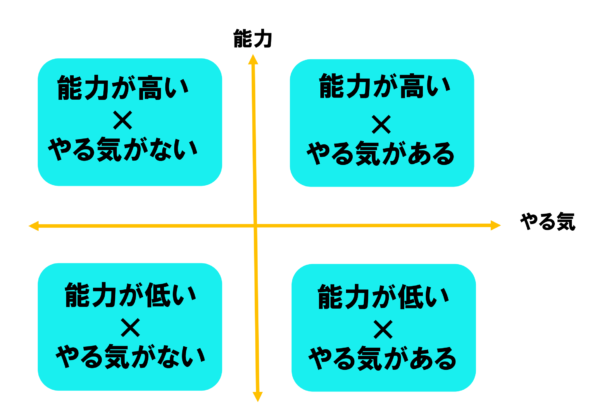
モルトケもまた、部下を4つのタイプに分け、組織において引き上げるべき(重用すべき)人間の優先順位を以下のように答えています。
- 能力が高く ✕ やる気が低い(有能な怠け者)
- 能力が低く ✕ やる気も低い(無能な怠け者)
- 能力が高く ✕やる気が高い(有能な働き者)
- 能力が低く ✕ やる気が高い(※無能な働き者:即刻除外)
この法則でも無能な働き者=能力が低いやる気のあるものは除外するべきと考えていますが、驚くべきことに、やる気満々の「有能な働き者」よりも、やる気のない「有能な怠け者」や「無能な怠け者」の方が、組織における重要度(評価)が高いとされています。
なぜなら、能力もやる気も高い人間は、時に我を出しすぎて上長(経営陣)のビジョンと衝突し、組織のコントロールを失わせるリスクがあるからです。現代の大企業が、あえて個性を抑え、指示通りに動く安定した人員(無能な怠け者)を多く採用するのも、この組織の安定性を求めた結果なのです。

能力・やる気が高い人物は、上長と衝突する恐れがあるので、優先順位は低いです。現代でも大手組織が個性を抑えた人員を採用するのはこの傾向があるのですね。
まとめ:他人の暴走に巻き込まれない「大人の賢さ」を身につけよう
今回は「無能な働き者」という、ビジネス界のワードについて解説しました。
会社という場所は組織であり、スタンドプレー(個人プレー)を行う場所ではありません。無能な働き者と呼ばれる人たちの最大の弱点は、「本人は一生懸命だけど、思考が100%自己中心的(客観性ゼロ)」という点にあります。他者から見れば、それは努力ではなく、ただの「自己満足のつもり」なのです。
もし、あなたの職場にそんな暴走列車のような同僚や上司がいて、毎日その尻拭いで疲れ果てているなら、まずは「仕組み」で徹底的に自分の身を守りましょう。指示を明確にし、勝手な判断の巻き添えを食わない防波堤を築くことです。
時代や国が変わろうとも、組織を崩壊させる原因はいつも同じ。他人の無駄なやる気に振り回されることなく、私たちはスマートに、戦略的に日々の職務をこなしていきましょう。
それではみなさま、今日も生産性の高い素晴らしい社畜ライフを!
“The Flawed Hard Worker”: Spotting the Office Liability and Mastering the Art of Not Getting Caught in the Crossfire
“In business, the most dangerous employee is the ‘flawed hard worker.'”
Have you ever heard this brutally intense phrase before?
“They stay in the office later than anyone else, and their motivation is through the roof. Yet, they constantly charge ahead blindly on dangerous assumptions, blow up projects, and leave everyone else to clean up their mess…”
Does this sound like anyone in your office? Across the globe, workplaces are collapsing under the sheer weight of “highly motivated incompetence.”
In this article, we will unpack the truth behind this famous tactical organizational theory. Written specifically for you—the exhausted frontline victim stuck handling the fallout—this is a Pro-Salaryman’s ultimate guide to identifying these runaway trains and mastering the art of not getting caught in their crossfire.
This page contains promotional content.
The Genesis: What is Seeckt’s Tactical Organizational Theory?
Why did historic military strategists say something as extreme as “shoot the incompetent yet diligent soldiers”?
This concept originates from Hans von Seeckt, a tactical mastermind and Commander-in-Chief of the German Army in the 1920s (alongside other legendary strategists like Moltke and Hammerstein). He was instrumental in rebuilding a highly effective military under strict post-war limitations.
In the military—an organization operating under extreme conditions where a single split-second mistake means literal death for the entire team—leaders categorized subordinates into four distinct types to ensure absolute tactical alignment. This century-old rule of survival still applies perfectly to modern office politics.
The Matrix: Facing the Brutal Truth of Human Nature
According to this framework, human suitability is plotted across two axes: Intelligence (Capable vs. Incompetent) and Diligence (Hard Worker vs. Slacker). Let’s look at how your coworkers—and your boss—fit into this matrix.
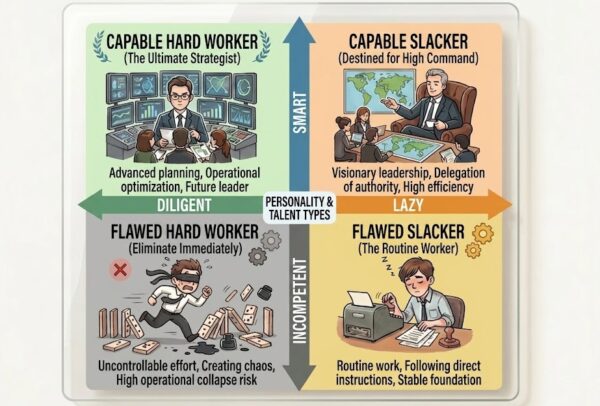
・Smart ✕ Lazy = Capable Slacker (Destined for High Command)
・Smart ✕ Diligent = Capable Hard Worker (The Ultimate Strategist)
・Incompetent ✕ Lazy = Flawed Slacker (The Routine Worker)
・Incompetent ✕ Diligent = Flawed Hard Worker (Eliminate Immediately)
Smart ✕ Lazy = The Capable Slacker
“Those who can get things done without micromanaging are the ones best suited for high-level command.”
It sounds ironic, but because these people are smart yet inherently “lazy,” they are completely obsessed with efficiency. They constantly think: “How can I get maximum results in the shortest time by delegating everything to others?”
They excel at identifying core traits, issuing precise orders, and leveraging human resources. This is the ideal mindset for business owners, CEOs, and top executives.
Because they want to relax, they clarify the chain of command and move the organization wisely. A corporate structure where an excellent top manager moderately delegates to the frontline is always the strongest.
Smart ✕ Diligent = The Capable Hard Worker
“Brilliant minds who take action are perfect for crafting and executing the master plan.”
These individuals take high-level tactical visions, turn them into flawless, actionable strategies, and get their hands dirty executing them. In the corporate world, these are your star players, high performers, and top-tier middle managers who drive practical operations forward.
They are highly reliable team pillars who lead the frontline with outstanding skills. However, as the saying goes, “A great player doesn’t always make a great manager.” Moving up to the executive command level requires a completely different skill set.
Incompetent ✕ Lazy = The Flawed Slacker
“Do not give them autonomy. Assign them repetitive, clearly defined tasks.”
These employees do not innovate, pitch new ideas, or take spontaneous initiative, but they follow instructions and company manuals perfectly.
Seeckt argued that 80% to 90% of an organization should consist of this layer. They serve as the stable, predictable workforce required for routine operations and standardized administrative tasks on the frontline.
This might sound harsh, but being a “flawed slacker” is honestly the comfiest way to survive corporate life. The logical approach of “I’d rather trade my time for a stable paycheck than take high risks for big returns” is absolutely essential for organizational stability.
Incompetent ✕ Diligent = The Flawed Hard Worker
“The most terrifying person is the one who lacks capability but possesses unlimited motivation and acts entirely on their own.”
This is the exact type of person the German military labeled as a total catastrophe, famously whispering that “there is no choice but to shoot them.”
They are incredibly enthusiastic, but they constantly misinterpret orders from management, skip team alignment, and sprint headfirst in the wrong direction—triggering massive corporate disasters. What makes them truly dangerous is their complete lack of self-awareness. Because they “worked so hard” and had “good intentions,” they never understand the root cause of their failure and will repeat the exact same mistake next week. They destroy discipline and cause maximum damage to the team.
This is the exact type of person the German military labeled as a total catastrophe, famously whispering that “there is no choice but to shoot them” — or as we modern office workers say, they must be “Eliminated Immediately” from the operation.
“The harder they work, the more chaos they create for everyone else.” There is nothing scarier than the misguided, innocent enthusiasm of a flawed hard worker. Check out the warning signs below to see if your coworker is driving your team off a cliff.
The Red Flags: The “Flawed Hard Worker” Risk Checklist
These agents of workplace chaos share almost identical behavioral traits. Does the problem child in your office tick any of these boxes?
・Abysmal at “Hou-Ren-So” (Reporting, Updating, Consulting), but Fast with After-the-Fact Excavations They charge ahead blindly without consulting anyone because they don’t think beforehand. They only drop a casual “So, actually…” after the project has completely blown up into an irreversible crisis, causing the cleanup costs for everyone else to skyrocket. No successful project in the world revolves around them.
・Mass-Producing the Exact Same Simple Mistakes Even after being warned about a task, they fail to grasp the core logic behind it, making it impossible for them to adapt. Their favorite defense is the “apology performance”—spamming “I’m so sorry!” to get through the moment. Because it’s just a performance, they change nothing, adapt to no new contexts, and repeat the same error the moment the format shifts slightly.
・Relying on Dangerous, Unfounded Assumptions They lack risk management skills and basic imagination. Even with unproven methods or unfamiliar tasks, they start optimistically thinking, “It’ll probably be fine!” Their lack of imagination regarding worst-case scenarios is fatal. This can grind work to a halt, cause missed deadlines, and bring irreversible financial damage to the company.
・Hoarding Work Uselessly While Delivering Abysmal Output Despite their low efficiency, they actively try to hoard as many tasks as possible beyond their capacity. They fall in love with the drama of being “swamped” and get a strange sense of self-satisfaction from staying late, even though their actual results are virtually nonexistent.
・Misunderstanding “Responsibility” and Rejecting Team Input True professional responsibility means delivering quality work on time. For them, responsibility means refusing to let anyone else touch the task. They get defensive or throw tantrums when managers try to redistribute their workload, forcing the team to match their slow pace and grinding everyone’s progress to a halt.
・Delusional Pride and High Self-Evaluation They have zero awareness of their own incompetence. They have an oddly high bounce-back rate from failures, brush off constructive feedback, and secretly look down on others. They blame the environment or external factors for their mistakes, creating a massive gap between their self-image and reality.
Survival Guide: How to Handle a Flawed Hard Worker Boss
In a corporate hierarchy, a manager can choose their subordinates, but an employee rarely gets to choose their boss. If your direct manager is a flawed hard worker, your mental health and time are going to be steadily eroded.
This is driven by a well-known organizational phenomenon called The Peter Principle:
“Every useful means is applied to increasingly difficult problems in succession, and eventually fails.”
Applied to a corporate setting: Employees are promoted based on their success in previous roles until they reach their level of incompetence. As a result, middle management tends to be occupied by incompetent individuals, leading to stagnant management across the board.
“They were excellent as a player, but turned incompetent as soon as they became a boss” is a classic office tragedy. They never received proper leadership training, so their unchecked motivation idles, creating a toxic boss who hoards work, steals credit, and passes down incredibly vague instructions.
Red Flags of a Flawed Hard Worker Boss
・Hoarding work and refusing to let go.
・Constantly trying to claim all team credit.
・A mysterious, rapid increase in turnover under their watch.
・Vague, disorganized handoffs.
・Zero respect for or awareness of deadlines.
・Spending 90% of their time on vanity projects that bring no revenue.
・Indecisive and paralyzed when a call needs to be made.
Tactical Countermeasures
Escalate to Higher Management with Hard Facts: Do not complain using emotional arguments. Document the delays, lost revenue, and concrete damages caused by your boss’s rogue decisions, and present this data directly to executive leadership.
Leave a Paper Trail for Everything: To counter their habit of changing their minds constantly, always summarize verbal conversations in writing. Send a follow-up email or Slack: “Per our discussion, I will proceed with the understanding of X, Y, and Z.” This shields you from taking the fall for their self-judgment.
Recognize a Sinking Ship: If executive leadership actively ignores this toxic manager and expects you to quietly clean up their mess for low pay, the entire corporate culture is broken. “A fish rots from the head down.” Always keep your CV polished and have an exit strategy.
Manager’s Playbook: Managing a Flawed Hard Worker Subordinate
For the managers leading teams: under modern labor laws, you cannot simply fire someone just because they are incompetent, especially since they show “high motivation.”
Since you cannot take your eyes off them without risking a disaster that pressures your own workload, the only solution is Absolute Behavioral Restriction Through Systems.
・Deconstruct Tasks into Micro-Steps: Vague instructions guarantee a disaster. Outline exactly what needs to be done next, leaving zero room for them to “improvise” or “add their own creative twist.” Manage them with strict manuals. ・Institutionalize Updates as a Mandatory System: Don’t wait for them to reach out. Create a rigid reporting schedule that bypasses individual discretion (e.g., mandatory text updates precisely at 10:00 AM and 5:00 PM) to force absolute visibility. ・Enforce Output and Deadlines Over Effort: Stop praising their “hard work” or long hours. Align expectations strictly on results: “Did you deliver the specific file by the specific deadline? Yes or No?” Focus purely on data, not the process.
This is basic training you would usually give to fresh graduates, but flawed hard workers are fatally missing this “foundation of moving within an organization.” A leader’s persistent re-education and rigid structural systems are mandatory.
Moltke’s Law: Why “Capable Slackers” Outrank “Capable Hard Workers”
To fully master this matrix, we must look at Moltke’s Law, coined by Helmuth von Moltke, the legendary Chief of Prussian General Staff and right-hand man to Bismarck.
When ranking which types of individuals should be promoted and valued within an organization, Moltke provided this surprising hierarchy of importance
- High Capability ✕ Low Motivation (The Capable Slacker)
- Low Capability ✕ Low Motivation (The Flawed Slacker)
- High Capability ✕ High Motivation (The Capable Hard Worker)
- Low Capability ✕ High Motivation (The Flawed Hard Worker – Eliminate Immediately)
Why is a “Capable Slacker” or even a “Flawed Slacker” with zero motivation preferred over a highly motivated “Capable Hard Worker”?
Because employees with high capability and extreme ambition often develop massive egos. They are highly likely to clash with the board’s vision, disrupt the alignment, and cause a loss of organizational control. This is precisely why global corporations often prefer stable, predictable individuals who simply execute the blueprint perfectly (flawed slackers) to maintain long-term stability.
High-flying mavericks pose a structural risk of clashing with upper management, which lowers their corporate priority. The reason large modern organizations still hire personnel with suppressed individuality today is a direct result of this stability seeking.
Conclusion: Arm Yourself with the Wisdom to Avoid the Crash
A corporation is a collective machine, not a playground for individual stand-play. The tragic flaw of the “flawed hard worker” is that their efforts are 100% self-centered—they completely lack objectivity. To them, it looks like earnest effort; to the rest of the team, it’s just destructive self-indulgence.
If you are currently trapped under a boss or next to a coworker who acts like a runaway train, build your systemic walls immediately. Clarify instructions, get everything in writing, and build a solid breakwater so you never take the fall for their arbitrary judgments.
No matter how times or countries change, the catalyst for organizational collapse remains identical. Do not let someone else’s misguided, useless enthusiasm ruin your focus. Work smart, stay strategic, and look after yourself.
Have a highly productive and wonderful corporate slave life today, everyone!